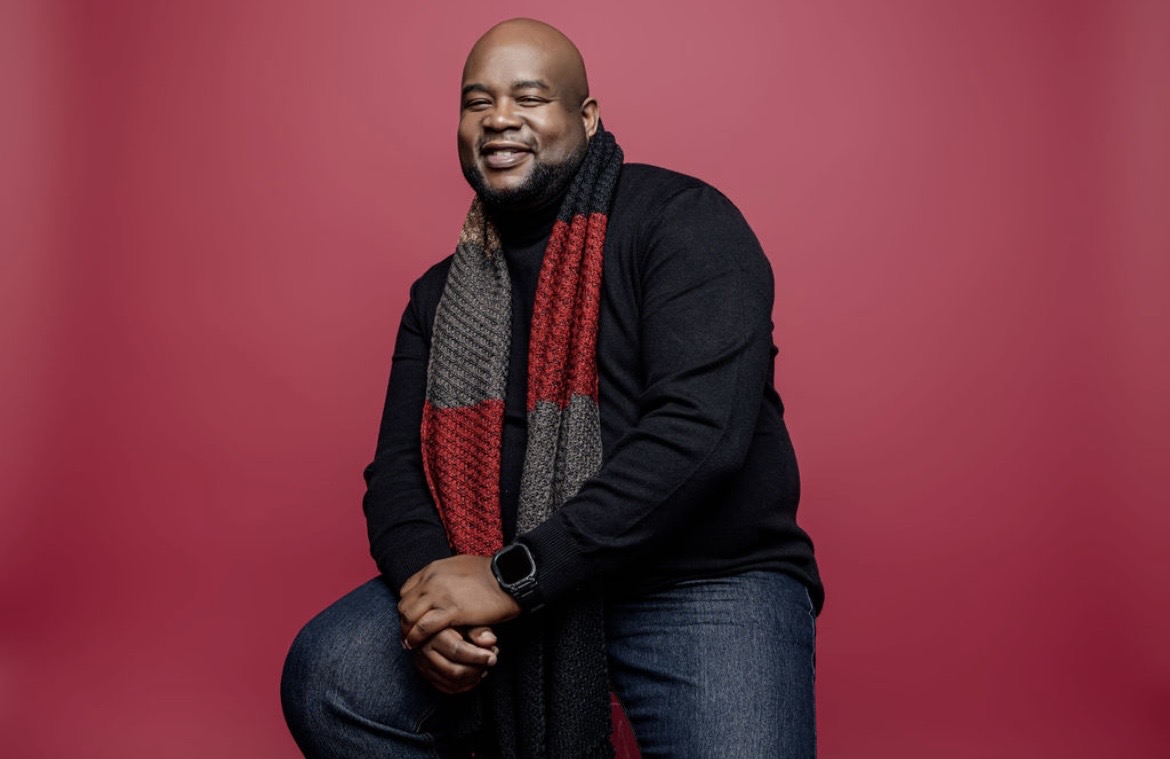
Twenty-one years a soldier, three years at King County, and a founding member who joined Vantage the afternoon he found it, because he is looking for his people.
WhoWilliam Herbert, King County Government
What they doYoung men and students around Seattle, through his fraternity's mentorship groups, the Breakfast Club, the Rescue Mission, food banks, and the Divine Nine scholarship luncheon every spring. What changes: they get shown how, by someone who was shown how.
What they give the roomA door into community work. Mentorship groups for middle and high school students, the Rescue Mission two Saturdays a month, food banks, blood drives, the Breakfast Club. If you want to serve and do not know how, he knows how.; A network that runs from the Urban League of Metropolitan Seattle and the Tacoma Urban League through the Divine Nine to the elders of the Central District.; Public-sector perspective from inside King County, after 21 years in the military.; Discernment. He knows which rooms to listen in. And a reading list, on Audible, for the gym.
The intro they needHis people. Specifically: grant writers, and people who want their money to go somewhere real, like the scholarships his fraternity presents at the Divine Nine luncheon every spring and the Masquerade Sneaker Gala every other year. And a way to match people who want to serve with the organizations that need them.
Where to find themhttps://www.joinvantage.co/members/william-herbert
William Herbert's application said he is not building anything, and that being in a circle with great people matters to him. This episode opens on that sentence, because it turned out to be the whole conversation.
He has his day-one brothers, fourteen of them, all married now, all leading households. He has family. He has work. And he has the space in between, which he calls the village, and which he is still trying to figure out. He has goals; he just does not know what they look like anymore. What he does know is that he wants to help other people reach theirs, and that somewhere in that, his own will show up.
The community work is the spine. Mentorship groups for middle and high school students through his fraternity, one of the Divine Nine. The Rescue Mission two Saturdays a month. Food banks. Blood. A scholarship luncheon every spring that the Divine Nine organizations have hosted for more than 20 years, and a Masquerade Sneaker Gala every other year. What he wants from a room like Vantage is specific: people who want to serve and do not know how, and people who know grant writers. He went to an HBCU because of A Different World; he saw a village of people who looked like him and wanted that.
The quick fires get a recipe (golden milk: turmeric, homemade almond milk, salt, pepper, cinnamon, sometimes ginger) and a reading list he listens to in the gym: The Let Them Theory, Olaudah Equiano, W.E.B. Du Bois, Black AF History, Jesse Rhodes Jr.'s book, and Atomic Habits for the fourth time.
The best room he ever walked into had John Lewis in it. William was a government fellow for him. Lewis walked up, gave him the fraternity grip, gave him a hug, and William burst into tears. Elijah Cummings and Shawn Stockman of Boyz II Men were in that room too, all fraternity brothers. And then the Central District: the Urban League, the Breakfast Club, men in their 70s, 80s, and 90s still fighting, and William, at 50, walking in, taking a deep breath, and listening. His mother taught him you can say everything you need to say by keeping your mouth shut, and that the difference is knowing when. Discernment, and integrity. Not as plentiful as you would imagine.
What he gives the room: a door into community work most people say they want to do and never start, a network from the Urban League to the elders of the Central District, and a man who knows when not to talk. What he is looking for: his people, grant writers, and people who want their giving to land somewhere real.
Read the transcript
Rachael Barclay (00:00)
you mentioned in your application that you're not building anything, but being in a circle with great people is important to me. And so...
what does a circle like that give a person and what do the rooms you've been in before get right or wrong? And I think what I'm looking for here is I know you're a member of a fraternity and I saw something about Divine Nine, although I'm not familiar, but it seems like you're very involved in community and you're looking for that again, as you just shared. So why is that circle
William R. Herbert (00:27)
Yeah.
Rachael Barclay (00:27)
of community so important?
William R. Herbert (00:30)
So that's a good question. so I think so the first portion is I'm thinking kind of said it earlier,
I think I think our village of what our village looks like.
I think when you first start looking for your village and you start to find it, and just when you think you found it, you find other parts of your village and it gets bigger. Right? Or
Rachael Barclay (00:54)
Okay.
William R. Herbert (00:55)
it gets smaller, right? But I've never really had an opportunity outside of my so I've got like my friend group, like my day one brothers, it's like fourteen of us. Like we were all single at one point, we were all outside, and then
And we all got married and had kids and leading our households and and then there's this there's this space that's in between
Professional
Family and friends and Uber.
Rachael Barclay (01:26)
Yeah.
William R. Herbert (01:27)
It's like I don't know the name of it. It's just this
Rachael Barclay (01:31)
Mm-hmm.
William R. Herbert (01:32)
space. And then it ends up becoming a village. And then it's slowly, if you're one of those people that you want that to happen, it moves into your your familiar space, right? But my
Rachael Barclay (01:44)
Mm-hmm.
William R. Herbert (01:45)
familiar space is always something I can always lean into as my say space, always. The space in
Rachael Barclay (01:50)
Mm-hmm.
William R. Herbert (01:51)
between those two entities,
I'm trying to figure out what that village looks like.
Rachael Barclay (01:57)
Mm-hmm.
William R. Herbert (01:58)
from a professional standpoint, I have goals. I just don't know what they look like anymore. I do know that I have aspirations. I know that there are other people that have aspirations too.
Rachael Barclay (02:10)
Thank you.
William R. Herbert (02:11)
And somewhere in there, I want to be able to help people achieve what those are. And along the way, maybe figure out what mine are. And along the way, maybe figure out how to help mine.
And I feel like what brings me into that space is the ability to do that.
Rachael Barclay (02:29)
Okay.
William R. Herbert (02:31)
as a person that I do a lot of work in the community with my fraternity.
I run mentorship groups with middle schoolers, high school students.
Rachael Barclay (02:43)
and
William R. Herbert (02:44)
we I volunteer at the rescue mission at least two Saturdays out of the month, food banks, every Saturday, give blood. There's a lot of stuff that not only just myself, other brothers that that that are a part of this great fraternity of mine that do.
Rachael Barclay (03:05)
Yeah.
William R. Herbert (03:06)
there's a space there where I want to be able to tap in with people that want to serve the community but don't necessarily know how. Hey man, if I
Rachael Barclay (03:17)
Hey.
William R. Herbert (03:17)
can meet some affluent people that got some money in a bank that may want to even write a grant or something for
Rachael Barclay (03:23)
Mm-hmm.
William R. Herbert (03:23)
some of these young kids. Cause we give we give fundra we we do fundraisers every year because we present scholarships every year. Like
The whole D nine, which is a organization of all historic black fraternities and black sororities, we're a part of this large organization.
Rachael Barclay (03:43)
Okay.
William R. Herbert (03:45)
and every year in May, April timeframe, we host a luncheon in which all of these organizations present scholarships to young kids going to school.
And we've
Rachael Barclay (04:00)
Yeah.
William R. Herbert (04:00)
been doing that for like over 20 years. I've been a part of my fraternity for at least 10. And so we've been doing
Rachael Barclay (04:06)
Yeah.
William R. Herbert (04:07)
this that long. And so being able to tap into network of people, some people that may want to serve community but just don't know what that looks like. Don't know how they want to feel that their money's going to a great cause, their time goes to a great cause. I want to tap into those people.
Rachael Barclay (04:28)
Yeah.
William R. Herbert (04:29)
I d I didn't realize it until maybe a couple days ago when I was trying to figure out I really want to be able to answer this question in a different way when you're asking it. and I was like, I I would love in in in my travels in the on this journey, I would love to find people that know grant writers, that would love to to grant write something simple. We have a gala that's coming up at the end of this month.
that we host every other year, Masquerade Gala. it's our s masquerade sneaker gala, so we get to show off our our kicks. Yeah. It's called a masquerade
Rachael Barclay (05:03)
I know it. I've seen that. What is it called? I think so.
William R. Herbert (05:08)
ball. Let me see if I can find it and and plug you in. But it's gonna be at the Muckleshoot Casino this year. And it's something that we do every other year.
And
so there's just a lot of when it comes to the work that we do in the community, like I do not shy away from it. I tell people this is stuff that I believe in, and this is stuff that I see work in real time. and at the end of the day, I if it was these things that essentially saved my life when I was a young kid.
Rachael Barclay (05:40)
you
William R. Herbert (05:41)
you know what I'm saying? I went to an HBCU because this show that I watch called A Different World.
Rachael Barclay (05:46)
yeah.
William R. Herbert (05:48)
Right,
like I saw I saw a village of people
Rachael Barclay (05:53)
Mm-hmm.
William R. Herbert (05:53)
that look like me. Right.
Rachael Barclay (05:56)
Mm-hmm. So important.
William R. Herbert (05:57)
And I want that experience. Right. You know what saying? And so and so to be able to be giving back to like communities and watching communities continue to be built.
Doing the things that we all love, helping the kids that we love. Like yeah. So yeah, I do a lot I do a lot of work.
Rachael Barclay (06:21)
That's everything.
William R. Herbert (06:22)
I can talk about com yeah, it's everything to me. It's part it's part of my being. Yeah.
Rachael Barclay (06:28)
We should talk another point about the volunteering, like matching the organizations who need things with the people who don't know how to connect with those, because
William R. Herbert (06:37)
A V.
Rachael Barclay (06:38)
that's another feature that we're working on with Vantage. So just like, how do you
William R. Herbert (06:43)
Yeah, we do a lot of work with the
Rachael Barclay (06:44)
bring that together?
William R. Herbert (06:46)
Yeah, we do a lot of so a lot of us are also members of the Urban League of Metropolitan
Rachael Barclay (06:51)
Mm-hmm.
William R. Herbert (06:51)
Seattle, as well as the Tacoma Urban League, Seattle Urban League. So yeah, we do a lot of times the work that we're doing in this entity kind of moves in orbit with the work we do in some of these other organizations because a lot of those people in those organizations are also members.
of those same set fraternities and sororities. And so we're just
Rachael Barclay (07:16)
you
William R. Herbert (07:16)
all just moving. So we all know each other, right? It's just a very
Rachael Barclay (07:19)
Mmm, mm-hmm.
William R. Herbert (07:21)
tight, it's just a very tight knit group. Like I found I found the other day I was sitting in a meeting and I found that there was someone that graduated the same year as me and I never talked to them on a campus. But then I was looking at pictures and we found out that we were all in the same photos together. And we were like, how is that? Like
Like how is that? Like in what world? Like you know what I'm saying that that happened.
So yeah. So yeah, when it comes to like the the community aspect, like that's a very big thing for me.
Rachael Barclay (07:57)
I love them. So we kind of like answered a lot of questions I had prepared. So I'm going to go to, which is great, but I'm going to go to the quick fires that I have at the end.
William R. Herbert (08:08)
Mm-hmm. Yeah.
Rachael Barclay (08:10)
So what, and they're just like silly things. So what is your go-to coffee order or if you don't drink coffee, you know, the drink that you have every day.
William R. Herbert (08:20)
golden milk.
Rachael Barclay (08:22)
What did you say?
William R. Herbert (08:23)
Golden milk.
Rachael Barclay (08:25)
Golden milk. Is that like turmeric and milk?
William R. Herbert (08:30)
That's turmeric.
Rachael Barclay (08:30)
That is golden.
William R. Herbert (08:32)
I I make my own almond milk. So turmeric,
Rachael Barclay (08:35)
my gosh.
William R. Herbert (08:37)
almond almond milk, a little salt, a little pepper, and some cinnamon. It's good for your stomach.
Rachael Barclay (08:43)
Mmm.
William R. Herbert (08:44)
I I I I intermittent fast like like during
Rachael Barclay (08:48)
Yeah.
William R. Herbert (08:48)
like from like seven at night to like one in the afternoon.
Rachael Barclay (08:56)
Mmm.
William R. Herbert (08:57)
And so I usually like it's like the one thing that I allow myself to have. Like I have like that one and then I don't eat anything until like late in the afternoon. But it keeps you it keeps your keeps your stomach right and
Rachael Barclay (09:11)
Okay.
William R. Herbert (09:12)
and that's my thing. I love how it tastes too. It's good. yeah, put ginger in it sometimes.
Rachael Barclay (09:18)
Mmm. That's good. So that's what? That's 18 hours of fasting, right? And
William R. Herbert (09:25)
Yeah.
Rachael Barclay (09:26)
that's so good because autophagy then happens, right? And it starts like healing and repairing. Yeah, I did that before and I need to do that again.
William R. Herbert (09:31)
Mm-hmm. Mm-hmm. But I I get I get headaches sometimes and
I get headaches sometimes and then I just be like, so like right before I sat down with you, I made a bowl of grits,
Rachael Barclay (09:43)
Yeah.
William R. Herbert (09:45)
and then I and I put an egg over easy on top of it, and I was like
Rachael Barclay (09:53)
It's great too because when you don't,
William R. Herbert (09:51)
Felt so good. Felt amazing.
Rachael Barclay (09:54)
when you fast for so long, you then like enjoy the nutrition as nutrition is supposed to be enjoyed rather than like, you know, I don't know, snacking on things.
William R. Herbert (10:04)
I'm trying
yeah. Yeah, I'm trying. Yeah.
So we can do.
Rachael Barclay (10:07)
Yeah, that's all we can do.
Okay, so what is a book that you recommend to people, either one that you've read recently or your favorite book or like I'm an audible person more than a sitting down reading person.
William R. Herbert (10:25)
Yeah, so I've been
yeah, so I've been reading a lot of books. I do a lot of audible books. so I'm kind of in between
The Let Them Theory. I just actually finished the Let Them Theory. and I'm currently so these my can't really see it, so listening to like Yeah.
Rachael Barclay (10:48)
the 48 laws of power.
Can't read that one.
William R. Herbert (10:53)
So the second one is the narrative of Olaudah Equiano, who is essentially was
Rachael Barclay (11:01)
Mmm.
William R. Herbert (11:01)
like one of the first free slaves Caribbean.
Rachael Barclay (11:05)
Hmm
William R. Herbert (11:07)
and the third one is W. E. B. Du Bois, the fight for equality, and the essentially American freedom. So
Those are the three books that essentially I've been reading the most.
A book
That I
So if you are a person that has been a parent for a while
or even a person that is moving into this space of like of trying just let go. the let them theory
Rachael Barclay (11:37)
Hmm.
William R. Herbert (11:38)
is a really good book by I don't know if you ever heard it by Mel Robbins.
Rachael Barclay (11:42)
Mm It's that green one you can
William R. Herbert (11:43)
And
Rachael Barclay (11:43)
see. don't know if you can see it behind me that's shining in the blur. Yeah.
William R. Herbert (11:47)
Is that what it is? Is that it? Cool.
I love it. Another reason why you and I get along great, 'cause cause you got got good taste in books. Yep. Yep. Yep. And so,
Rachael Barclay (11:53)
Yeah.
William R. Herbert (11:59)
I think I don't know if you look if you look at mine, you can see I'm almost done with mine.
Rachael Barclay (12:08)
Yeah, it's such a good book.
William R. Herbert (12:08)
I think I got like two hours left.
and another book, I would say well two more books. One
Rachael Barclay (12:18)
I love it.
William R. Herbert (12:19)
Black AF History by Michael Harriot, Black as History, by Michael
Rachael Barclay (12:23)
Mm-hmm.
William R. Herbert (12:24)
Harriet. and it basically talks about it it's it has a breakdown of
our history, our real history
Rachael Barclay (12:33)
Okay, get it.
William R. Herbert (12:34)
without all the whitewashing, in a very peculiar entertaining way of Michael Harriot, because he pulls no punches, he just says things first brand, and either you gotta have a stomach for it or you don't. But if you do, just
Rachael Barclay (12:51)
Mmm.
William R. Herbert (12:52)
know you fit in a laugh a lot and you're fitting to be like, okay.
And then the last book is Leadership Unlocked by Yours Favorite. That's right. Yeah. is that one back there too? Okay, cool. Yeah, I'm like I'm like
Rachael Barclay (13:02)
Yeah, Jesse Rhodes. Yeah, that one's back here too. Yeah.
William R. Herbert (13:10)
three I'm like two hours in it. there it is.
Rachael Barclay (13:12)
I got my signed copy.
William R. Herbert (13:14)
I just I just finished reading Atomic Habits for the fourth time.
I I listen to that a lot when I exercise. Like if I'm in the gym
Rachael Barclay (13:28)
that's a good idea.
William R. Herbert (13:28)
and I'm lifting weights, I'll just I'll just be sitting there just on the bench. Just
Rachael Barclay (13:34)
That's an atomic habit. Right there. huh.
William R. Herbert (13:37)
Yep. Yep. So Atomic Habits
is is is another book. so yeah. I do listen to I
Rachael Barclay (13:42)
I love that.
William R. Herbert (13:43)
do listen to a lot more books now. I didn't realize
How much listening to audiobooks through Audible would help me resonate with so many things versus
Rachael Barclay (13:55)
Mm-hmm.
William R. Herbert (13:57)
reading them. Because you read them, it's a it's a tenuous chore.
Rachael Barclay (14:03)
Mm-mm.
William R. Herbert (14:03)
Right? but you can
You could be driving in a car, I can drive in my car
Rachael Barclay (14:09)
Mm-hmm.
William R. Herbert (14:09)
and I'll be listening to Audible in my car or in the gym. Or I can be having conversations with you and you can say something and I can be like, I just heard that just the other day in this book that I was reading. And then I'll be like,
Rachael Barclay (14:23)
Mm-hmm.
William R. Herbert (14:24)
yeah, Let them Theory by Mel Robbins. She'd be like, Guess what? Guess you see that little green spot back there? That's my book too. But then so then you find out that other people are reading and listening to the same book. So
Rachael Barclay (14:34)
Mm-hmm.
William R. Herbert (14:34)
So yeah,
yeah, those are my books. I
do listen and read a lot though.
Rachael Barclay (14:37)
Kind of interesting, like, could you match
people on books? know, like, that's what I was thinking. I'm like, hmm, would that tell you about a person? I don't know. Like, pick which is your favorite.
William R. Herbert (14:46)
I d I didn't
I didn't I kinda cut out, what'd you say?
Rachael Barclay (14:49)
I said it's kind of interesting. I was thinking it's like could you match introductions based on books? know, like top five books. Like how would these people go together? Just an interesting thought. Yeah, yeah.
William R. Herbert (14:59)
Yeah. Yeah, that's fair. That's fair.
Rachael Barclay (15:04)
Okay, and then my last question is what is the best room you've ever walked into anywhere?
William R. Herbert (15:12)
But so many of man, but
Rachael Barclay (15:16)
It could be more than one, it could be a couple.
William R. Herbert (15:18)
So
So once upon a time
I worked as a government fellow for Honorable John Lewis.
And I remember
Walking into this room
with one of my frat brothers, brother Malwan Johnson, and
He was in there. He's also, he, God bless the soul, may he rest in heaven. He's also a member of the same fraternity as me. So I remember walking in, and like any fraternity, we have our own secret handshake. And I remember he walked right up to me and gave me the handshake and gave me the grip, and he gave me the biggest hug. And I burst into tears.
Rachael Barclay (16:11)
Mmm.
William R. Herbert (16:12)
And in that same room, it was him, brother Elijah Cummings.
Shawn Stockman from Boys the Men and
Rachael Barclay (16:24)
Mmm.
William R. Herbert (16:25)
several other people.
And I just remembered
I would see I would be in one meeting when I would see Brother Lewis all the time. And anytime I'd see him, I'd do one of these and he'd do one of these back to me. And he'd keep it moving. And I remember I I just man.
Rachael Barclay (16:50)
powerful.
William R. Herbert (16:51)
He's my frat brother. He's my frat brother. Me, he always be my frat brother. Shawn Stockman from Boys and Men's another frat brother that was in that room. And I just remember being in space with all these great people. There's so many other people. I probably can't even remember, but I remember being in space with him and brother Cummings.
Yeah, like just being in the space with some of these people, like, yeah. So I would say that room.
I would say
So
You have the history of Seattle, and then you have the history of the Central District, right?
Rachael Barclay (17:30)
Yeah.
William R. Herbert (17:31)
Which essentially is like the first it's like the first of many things of Seattle. It's like the first essentially neighborhood in which the rest of Seattle was built around it.
Rachael Barclay (17:42)
Thank
William R. Herbert (17:43)
first unincorporated like black neighborhood.
Rachael Barclay (17:48)
Mm-hmm.
William R. Herbert (17:50)
But I say all of that to say there are people that operate in that space to keep in that neighborhood what it is and to br continue
Rachael Barclay (17:58)
Thank
William R. Herbert (17:59)
to bring businesses and flourish to that neighborhood. but I've been in spaces working, you know, volunteering for the Urban League where I've walked in the rooms and I'm in the rooms with like black civil rights operators, like
Black Panthers. I'm part of a group called the Breakfast Club. which
Rachael Barclay (18:21)
Mmm.
William R. Herbert (18:21)
essentially is a a breakfast that we do one Thursday out of the month, and we have programs and events to help raise our young men, teach them how to tie a tie, teach how to how to dress up and interv you know, inter for interview and occasion. and so in that group, being in that group with those men are men that have been
heads of the Seattle City Council for like years and and so when I'm in those rooms
There's like so much history. And these are people, I'm fifty. And these are people that are like 70s, 80s, 90s year olds, like still fighting. So
Rachael Barclay (19:04)
Mm-hmm.
William R. Herbert (19:05)
anytime where I get to walk in those rooms,
Rachael Barclay (19:08)
Yeah.
William R. Herbert (19:09)
I just take a deep breath.
Rachael Barclay (19:13)
Mm-hmm.
William R. Herbert (19:14)
and
just be in space. And
Rachael Barclay (19:16)
Okay.
William R. Herbert (19:17)
there are lots I went to a lunch the other day and I was just brother Robert Jones, who's the president of Washington, who's also me and Jesse's frat brother. I went to a luncheon like two weeks ago with him and several others and
And a couple other people are like, You don't really say much. And I'm like, nah. I do love talking, but sometimes certain rooms I just know just to shut my mouth, man, and just listen. And he goes, you were raised right. And I was like, Yep, raised by my mama. So Yeah, raised by my mama. Sometimes yeah, sometimes
Rachael Barclay (19:49)
Yes, I was going to say that. You don't always need to talk.
William R. Herbert (19:56)
you can you know, and and it's funny that 'cause one thing that I've learned is if my mom says, he goes, Sometimes you don't need to talk. Sometimes
You have everything that you need to say, and you can say all of that by just keeping your mouth shut. And I'd just be like, Yes, ma'am. She goes, But the difference
Rachael Barclay (20:09)
Amen.
William R. Herbert (20:12)
but but my mom says the difference is is knowing when that is. So and so that comes she and
Rachael Barclay (20:18)
Mm-hmm. Discernment.
William R. Herbert (20:20)
sh she goes, Yeah, so use discernment and she goes, that comes with age. And I think one of the things that we were talking about is people don't use discernment anymore.
Rachael Barclay (20:30)
Mm-mm. Yep.
William R. Herbert (20:30)
And
and it just shows and just like how they operate and how they choose friends and even the choices that they make of like who they gonna ride with and who they gonna let let slide on, like when they do dumb stuff, right? Like all those things, right? And so I'm learning in my in my wise old years, I'm fifty, I'm not old,
Rachael Barclay (20:54)
Yeah,
really, I was going to say, I was going to let you get away with it, but it's okay.
William R. Herbert (20:57)
Yeah. Yeah.
I'm learn I'm learning in my wise old years that discernment's good. Find comfort in it. Find comfort in discernment and find comfort in operating with discernment. No. Mm-hmm.
Rachael Barclay (21:11)
and integrity. It's not as plentiful
as you would imagine.
William R. Herbert (21:18)
No ma'am, it is it it hey, it is not. You know, like
it is not.